Customer Acquisition Cost (CAC) is a critical metric that helps you understand the economics of your marketing efforts. This article explains what CAC is, why it matters, how it's calculated, and how to interpret the results shown in your Marketing Plan Overview.
Customer Acquisition Cost (CAC) represents the average amount you need to spend to acquire one new paying customer. In your Marketing Plan Overview, this is displayed as "cost per client."
CAC answers the fundamental question:
"How much do we need to spend, on average, to acquire one new paying customer?"
Understanding your CAC is essential before moving into your marketing roadmap, as it helps you determine whether your acquisition model makes economic sense for your business.

The CAC Overview appears in your Marketing Plan Overview screen, positioned between your Gap Analysis results and your 12-Month Growth Roadmap. This screen displays:
Cost per client - your calculated Customer Acquisition Cost
ROI summaries - showing returns at different time horizons
Break-even analysis - how long until your investment pays off
Navigation options - back to analysis or forward to your roadmap
CAC is one of the core economic checks in your marketing strategy. It provides critical insights that help you make informed decisions about your marketing investments:
Whether your acquisition model is affordable for your business
How quickly your marketing spend can be recovered through customer revenue
Whether the value of each customer justifies the cost to acquire them
How referrals can improve your overall acquisition economics
Without understanding your CAC, your marketing plan would show budget and revenue projections without explaining whether acquiring a new customer is actually worth the investment. CAC gives you the economic foundation to evaluate your marketing strategy.
Your CAC is calculated using a blended approach that considers all traffic-generating channels included in your marketing plan. Here's how it works:

The calculation aggregates the total investment associated with driving traffic and acquiring leads. This encompasses both paid media acquisition costs—such as pay-per-click or sponsored visibility campaigns—and strategic investments in organic traffic generation and search presence optimization.
Rather than a fixed list of channels, the calculation dynamically reflects the total spend allocated to the traffic sources active within your current agreement.
The calculation follows these steps:
Sum the 12-month traffic costs from all included marketing channels
Estimate the total number of customers generated across the plan horizon
Divide total traffic cost by total generated customers
Formula: CAC = Total traffic spend across plan / Total generated customers
Beyond the basic CAC calculation, your Marketing Plan Overview provides additional economic metrics to help you evaluate your marketing investment:
The break-even point tells you how many months it takes to recover your customer acquisition cost through customer revenue. It's calculated using your CAC and average monthly revenue per customer.
Formula: Break-even months = CAC / average monthly revenue per customer
The result is rounded up to the next whole month, giving you a realistic timeline for recovering your marketing investment.
This metric estimates the total revenue a customer can generate over their entire relationship with your business. It helps you understand the long-term value of acquiring new customers beyond the initial transaction.
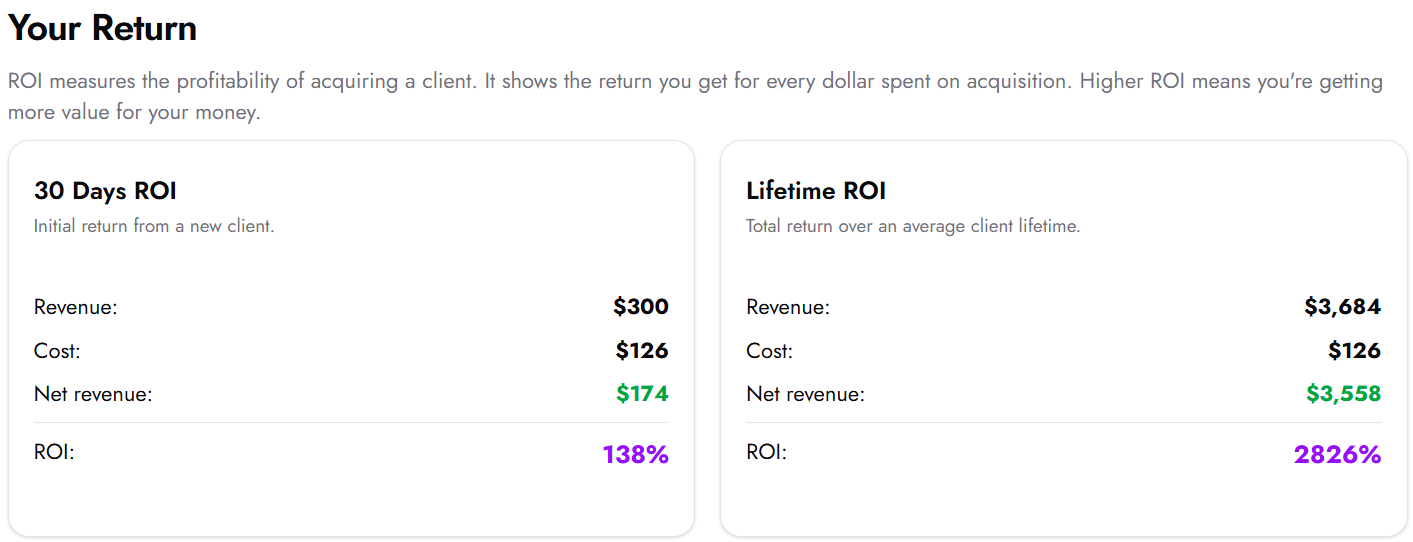
Your overview displays ROI calculations at multiple time horizons:
30 Days ROI - Short-term initial return from a new client
Lifetime ROI - Long-term return over an average client lifetime
For each time horizon, you'll see:
Revenue - Total customer revenue generated
Cost - Your customer acquisition cost
Profit - Revenue minus CAC
ROI Percentage - Profit expressed as a percentage of CAC
Profit with Referrals - How referrals improve your economics
ROI Percentage with Referrals shows how profitable your marketing investment looks after including extra business generated through referrals, not just the original customer revenue.
It’s meant to give a broader picture of return: if referrals add meaningful value, this percentage will look stronger than standard ROI and better reflect long-term growth.
Multiple factors influence your Customer Acquisition Cost:
Which traffic products are included in your plan
Product pricing and cost structure
Expected lead generation volume
Expected customer generation
Your close rate (leads that become customers)
Follow-up efficiency
Conversion assumptions
Overall customer economics
Your CAC improves when:
Traffic becomes more cost-effective
Website conversion rates increase
Follow-up processes become more efficient
Lead-to-customer close rate improves
Conversely, CAC increases when traffic is expensive, conversion is weak, follow-up is inefficient, or close rates are low.
Q: Why is my CAC higher than I expected?
A: CAC reflects the blended cost across all marketing channels in your plan. Higher CAC typically indicates expensive traffic sources, low conversion rates, or weak follow-up processes. Review your Gap Analysis to identify specific improvement opportunities.
Q: How can I lower my CAC?
A: Focus on improving conversion rates, response times, and close rates. Even small improvements in these areas can significantly reduce your effective CAC without reducing marketing spend.
Q: What is a good CAC?
A: A good CAC depends entirely on your customer value. As a general rule, you want to recover your CAC within 3-6 months, and your customer lifetime value should be at least 3x your CAC.
Q: Do referrals really make that much difference?
A: Yes. Referrals can dramatically improve your economics because they reduce the effective cost of acquiring new customers. A strong referral program can lower your blended CAC and increase overall profitability.